
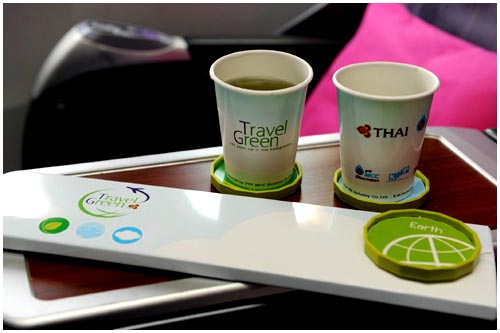
BioPBS Paper Cups Served on THAI’s First Biofuel Flight
Thai Airways International Public Company Limited (THAI) is the first airline in Asia to operate a commercial passenger flight using biofuel. Flight TG104 took off from Bangkok for Chiang Mai on December 22, 2011, as part of THAI’s policy to reduce global warming and promote the Company’s Travel Green initiative.
THAI is cooperating with the International Air Transport Association (IATA) to encourage the aviation industry worldwide to reduce carbon emissions. Aircraft today contribute 2 percent of total carbon emissions worldwide and, while this is very low compared with other industries, IATA estimates that by substituting 6 percent of fossil fuel with biofuels, the aviation industry will be able to achieve a 5 percent carbon reduction by the year 2020. Therefore, in order to meet IATA’s target in reducing aviation carbon emissions, collaboration to promote sustainable biofuel development is essential to ensure that there is an adequate supply at a viable cost.
In the challenge to produce sufficient levels of sustainable biofuels to meet the needs of aviation in Thailand, THAI will bring together both the public and private sectors, including fuel producers, research companies, education institutions, aircraft and engine manufacturers and different government bodies, as partners in the development. For example, for this flight PTT has lent support by obtaining eight tons of aviation biofuel from Sky NRG, a leading aviation biofuel agent in the Netherlands. Biofuels that have been tested by several international airlines, including Air New Zealand, Continental Airlines and KLM, have been of a quality comparable to Jet A-1 traditional petroleum-based fossil fuel and the American Society for Testing and Materials (ASTM International) has certified that biofuels combined with Jet A-1 fuel, at a maximum ratio of 50:50, can be used in place of pure Jet A-1 fuel in accordance with the ASTM D7566 standard.
In order that THAI’s special flight may truly be “Travel Green,” PTT MCC Biochem Co., Ltd. and PTT Polymer Marketing Co., Ltd. have cooperated with plastic producers to manufacture 100% compostable BioPBS-laminated paper cups that are being introduced for the first time to the business sector in Thailand. This example of cooperation is an important step in the country’s increasing global confidence and is evidence of its readiness to become the “Bio hub of Asia,” and demonstrates PTT’s vision and presence in the energy sector and its commitment to maintaining long term Corporate Social Responsibility.